
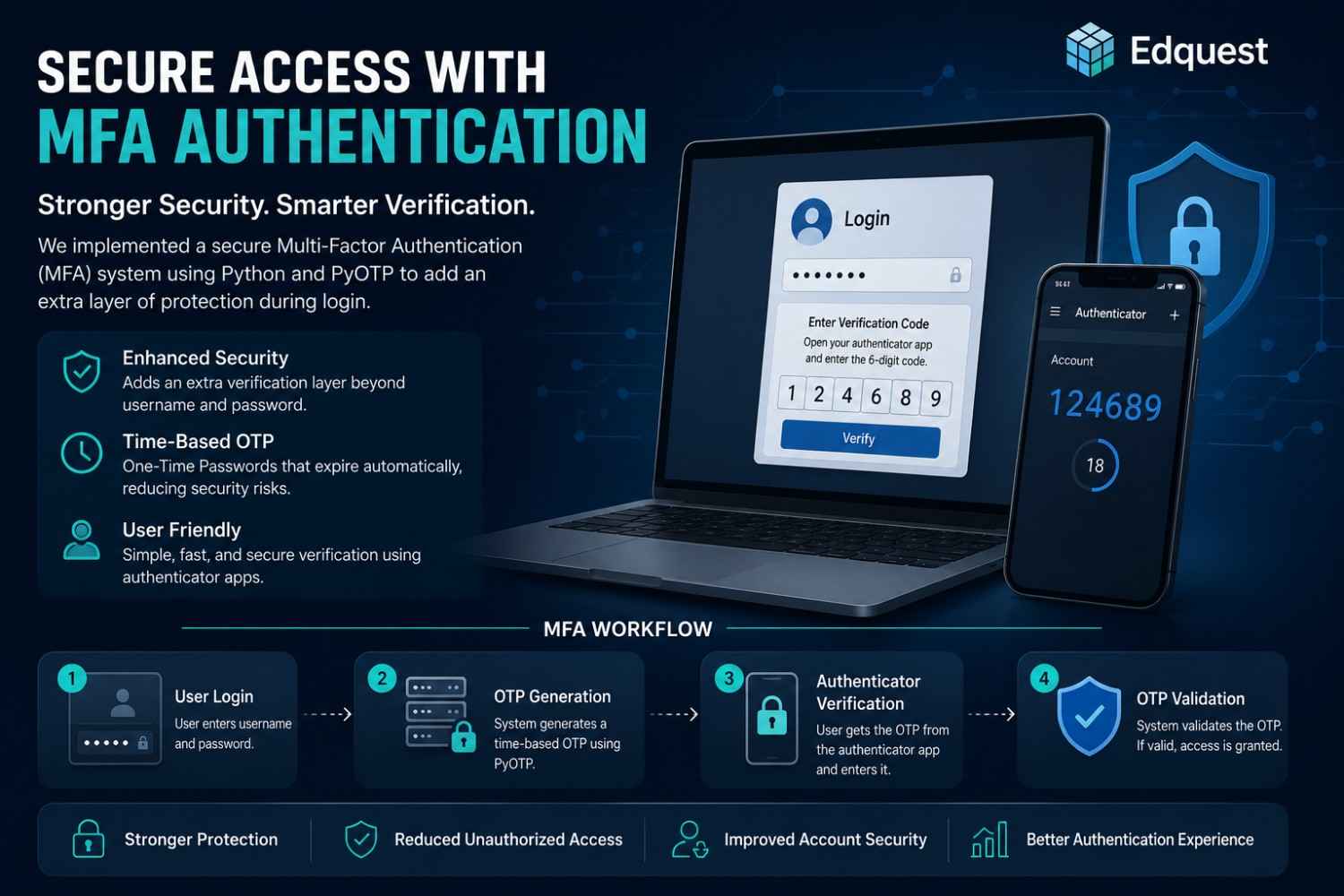
Modern applications require stronger authentication mechanisms to protect user accounts and sensitive business data. Traditional username and password authentication alone is no longer sufficient for securing modern systems. Unauthorized access, credential leaks, and password-based attacks continue to increase across web applications and enterprise platforms. To improve authentication security, we developed a secure Multi-Factor Authentication (MFA) Proof of Concept using the PyOTP Python library and authenticator applications. The system introduces an additional verification layer during login using time-based OTP authentication, helping applications strengthen account security and reduce unauthorized access risks.
The authentication flow follows a structured verification process designed to improve application security.
The user first enters their username/email and password. The application validates the primary credentials before moving to the secondary authentication layer.
After successful login verification, the backend generates a time-based One-Time Password (OTP) using the PyOTP Python library. The generated OTP changes automatically after a fixed time interval, improving authentication security.
The user accesses the generated OTP through an authenticator application and enters the verification code into the system. This creates an additional security layer beyond password-based authentication.
The backend validates the OTP entered by the user. If the verification succeeds, access is granted. If verification fails, authentication is denied. This ensures only verified users can access the application.
Implementing MFA significantly improves authentication security by:
Since OTPs are temporary and time-based, authentication becomes significantly more secure compared to traditional login systems.
MFA authentication systems are widely used in:
As cybersecurity requirements continue to grow, MFA has become a critical security layer for modern applications.
Secure authentication is becoming essential for modern applications and enterprise systems. By implementing MFA using Python, PyOTP, and authenticator-based OTP verification, we created a lightweight and secure authentication workflow capable of significantly improving login protection and application security. This POC demonstrates how modern authentication systems can strengthen access control while maintaining a smooth user experience.
Protect your users and sensitive data by integrating robust Multi-Factor Authentication into your existing applications.
Discuss Security Solutions