
Aviation operations don't fail because of a single bad decision. They fail because critical information — crew FDTL balances, certificate validities, post-flight data — lives in disconnected systems that don't talk to each other. For NSOP operators and charter companies across India, this operational fragmentation is the central challenge. Spreadsheets, shared drives, and manual coordination were workable at small scale. As fleets and rosters grow, they become liabilities. The answer is a structural shift: from isolated tools toward a connected digital operations ecosystem — where crew management, compliance, reporting, and documentation share a single operational picture.
A single crew scheduling decision requires a dispatcher to verify FDTL balance, medical certificate validity, aircraft airworthiness, and ground operations readiness — ideally before committing to a client. In organizations running disconnected tools, this means jumping between spreadsheets, email threads, and multiple applications. Every transition is an opportunity for error or delay.
As the organization scales, this friction compounds. The more aircraft and crew you add, the more administrative overhead grows — not the operational capacity.
A digital operations ecosystem is not simply a collection of software tools running side by side.
It is an integrated operational architecture in which the different functional domains of an aviation company — crew management, document control, compliance tracking, flight reporting, and operational coordination — share a common data layer, communicate state changes to one another in real time, and present a unified operational view to the people who need it.
In practical terms: when a crew member completes a training session, that qualification update is immediately reflected in the scheduling module, the compliance dashboard, and the document management system — automatically, without manual re-entry.
When a pilot's medical certificate approaches expiry, an automated alert is generated and the scheduling engine flags any future assignments that would conflict with the compliance gap. Data entered once propagates throughout the entire operational environment.
The four defining characteristics of a genuine aviation operations ecosystem:
A single authoritative source of operational truth that all modules read from and write to, eliminating data duplication and version conflicts.
Workflows that span multiple functional domains — for example, a crew assignment that automatically validates against FDTL, qualification, and aircraft requirements — without requiring manual coordination between those domains.
Dashboards and reporting interfaces that reflect the current operational state rather than a lagged, manually assembled view of it.
The ability to identify patterns, anticipate issues, and support decision-making based on structured operational data — rather than relying entirely on individual expertise and institutional memory.
An ecosystem of this kind is fundamentally different from deploying several good software tools independently. Integration is the operative word. Without it, operational efficiency improvements in one domain often fail to materialize organizationally — because information flow between domains remains manual.
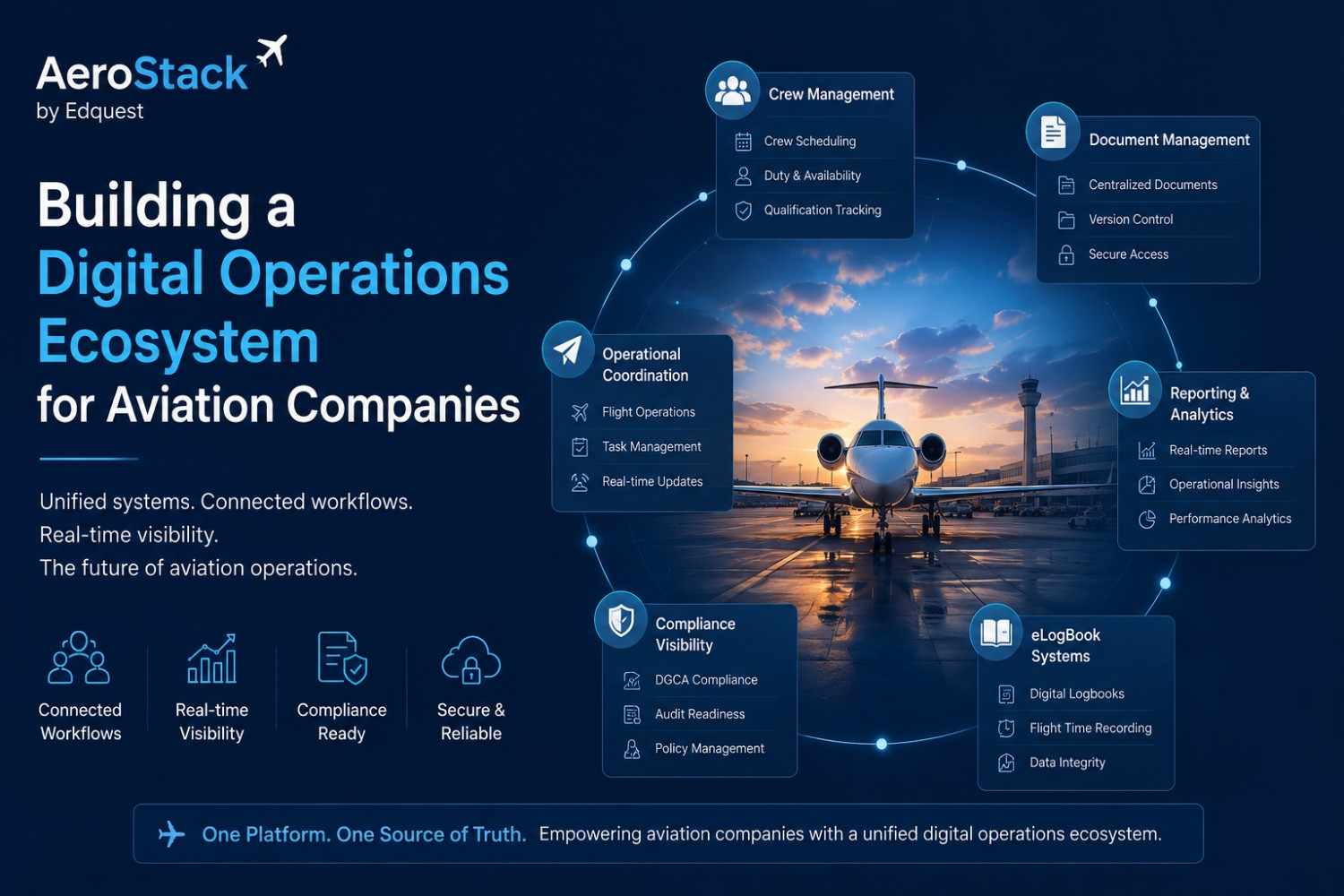
The most effective way to understand a connected aviation operations ecosystem is to see how its modules relate to one another. Rather than parallel tools operating independently, they form an interconnected system with a shared operational core.
At the center: the AeroStack aviation platform — a unified operational core that serves as the single source of truth for your entire operation. Every module reads from and writes to this core, creating a live, synchronized operational picture.
Scheduling, FDTL tracking, qualification management, and roster coordination — automatically validated against compliance requirements in real time. No more cross-referencing spreadsheets before every assignment.
Continuous automated tracking of crew licenses, medical certificates, and aircraft airworthiness against DGCA regulatory requirements — with proactive expiry alerts at 30, 60, and 90 days.
Digital crew flight hour records, automatically populated from post-flight sector reports — eliminating manual logbook entry and providing always-current experience data to operations and compliance teams.
Real-time operational dashboards fed by structured digital sector reports — turning raw flight data into decision-ready intelligence without any consolidation lag.
Centralized, version-controlled storage for aircraft manuals, crew licenses, and regulatory documents — with automated expiry tracking and audit-ready access from anywhere.
A shared operational context for dispatch, crew, ground operations, and management — replacing fragmented communication channels with a structured, fully documented flow of operational decisions.
The operational value is not found in any individual module. It is found in the connections between them — the way a compliance update flows automatically into crew scheduling, or the way post-flight data feeds analytics without manual intervention. That connectivity is what defines a true aviation operations ecosystem.
Each module within a connected aviation operations ecosystem addresses specific operational challenges. Here is how each contributes — both independently and as part of the broader platform.
Crew management sits at the center of most aviation operational decisions. It encompasses not only scheduling — matching pilots and crew to flights — but the entire lifecycle of crew qualification, availability, duty history, and regulatory compliance.
A Crew Operations Platform that operates in isolation handles scheduling, but leaves compliance and qualification verification to manual processes. In a connected ecosystem, these are unified — the scheduling module carries full awareness of every crew member's FDTL balance, medical validity, qualification status, and rest requirements.
Conflicts are surfaced before they create operational problems. Roster changes propagate immediately to all affected parties. The operational coordinator sees the complete picture — not a scheduling view in one application and a compliance view in another.
Shared drives and email are persistent sources of audit risk — version conflicts, expired certificates in active use, and manual retrieval delays are common failure modes.
A centralized document management system provides controlled access, automated expiry tracking, and version management. When a document is updated, it is immediately available organization-wide. Audit preparation shifts from days of retrieval to a report generated from a system that is audit-ready by design.
Digital post-flight sector reports — submitted directly by crew — feed a real-time reporting layer that surfaces fleet utilization, crew productivity, billing accuracy, and maintenance patterns without any consolidation lag.
For NSOP operators in India, DGCA compliance is not a periodic concern — it is a continuous operational requirement.
The regulatory framework governing crew certifications, aircraft airworthiness, operational manuals, and flight duty time limitations requires that an operator maintain a state of ongoing compliance, not just compliance at the point of audit.
Achieving this without a digital compliance layer requires dedicated administrative effort that scales poorly with organizational growth. A compliance monitoring module within an integrated platform changes this fundamentally.
Operations teams can proceed with confidence that any flight being planned or dispatched is compliant — because the system has already validated it. This is directly relevant to the challenges detailed in our guide to DGCA compliance for NSOP operators.
When eLogBook data is integrated with the operations ecosystem, flight hours are automatically populated from post-flight reports — no manual entry. Operations teams have current visibility into crew experience levels for both compliance and client briefing, and audit queries are answered instantly from structured records.
Phone calls, messaging apps, and email create operational decisions without shared context — instructions conflict, operational pictures diverge. A unified coordination layer routes flight assignments, status updates, and operational communications through a common platform that all participants reference in real time. This is most valuable during disruptions, where miscommunication is most costly.
DGCA compliance requirements are more comprehensive and more closely monitored than ever. Manual compliance management doesn't scale — integrated platforms deliver continuous monitoring that manual processes cannot.
Adding aircraft or crew to a disconnected system means adding proportional administrative overhead. Unified platforms break this relationship — capacity scales without equivalent coordination effort.
Crew utilization optimization, maintenance scheduling, and capacity planning require structured operational data. Organizations building integrated data infrastructure now are developing capabilities that fragmented systems cannot replicate.
When operational data is centralized and current, recovery from disruptions — aircraft AOG, crew unavailability, weather diversions — is faster, more coordinated, and verifiably compliant.
The AeroStack aviation platform integrates crew management, document control, compliance monitoring, and reporting into a unified operational core — replacing fragmented tools with a single source of truth.
Built for the realities of Indian NSOP operators, AeroStack delivers enterprise-grade operational capability without enterprise implementation complexity. The platform's true value is connectivity: data entered in one module is instantly available everywhere.
Aviation software is evolving rapidly toward deeper integration and intelligent automation. The organizations building connected infrastructure today will be positioned to leverage tomorrow's capabilities:
Routine compliance checks, renewal notifications, and reporting will execute automatically, drastically reducing administrative overhead.
Pattern recognition and AI-assisted scheduling will surface insights from structured data, augmenting human decision-making at the point of action.
Enterprise-grade operational platforms are now accessible to operators of all sizes without massive capital investment in IT infrastructure.
The foundation you build today determines the operational ceiling you can achieve tomorrow.
An integrated platform where crew management, compliance, document control, reporting, and coordination share a common data layer — so information flows automatically across functions instead of being transferred manually.
NSOP operators navigate strict DGCA requirements across crew, aircraft, and documentation simultaneously. Centralized platforms provide the real-time compliance visibility and automated FDTL tracking that disconnected tools cannot deliver at scale.
AeroStack continuously monitors certifications, medical validities, and airworthiness records — generating automated expiry alerts and validating crew assignments before confirmation, keeping the operation audit-ready at all times.
Individual software tools handle single functions. An ecosystem connects them — so a qualification update in crew management is immediately visible in scheduling, compliance, and reporting without any manual transfer.
Yes. AeroStack is modular — start with the capabilities most relevant today and expand as your operation grows. The benefits of connected workflows and compliance visibility apply at any fleet size.
Aviation operations will continue to grow in complexity. Regulatory requirements will become more comprehensive, client expectations will rise, and the competitive environment for NSOP operators will intensify. The organizations that navigate this environment successfully will be those that have built operational infrastructure capable of supporting that complexity — not merely tolerating it. A connected digital operations ecosystem is the operational foundation that makes scale possible without proportional growth in administrative overhead. It is how aviation companies achieve continuous compliance visibility rather than periodic audit readiness. It is how operational data becomes a decision-making asset rather than an administrative burden. The direction is clear. The question is when your organization chooses to build on it.
Fragmented workflows, manual FDTL tracking, and scattered compliance records are operational liabilities — not just inconveniences. AeroStack is built to unify your crew management, document control, compliance monitoring, and reporting into one connected platform. Designed for NSOP operators. Built for operational scale. No enterprise implementation complexity.
Explore AeroStack Platform